Digital Photography News and Digital Camera Reviews
Showing posts with label Canon SLR. Show all posts

Digital SLR Camera - Canon Rebel XS

Canon has announced its latest digital SLR camera, the EOS 1000D, which will be known as the Canon Rebel XS in North America. Featuring a 10.1 megapixel CMOS sensor and the famous EOS design, the Rebel XS is well poised to be a big hit. Cheaper than its bigger brother, the Canon Rebel XSi, the Rebel XS is expected to appeal to a wider audience and casual photographers making the jump to digital SLR cameras.

The Canon Rebel XS digital SLR camera will have a 2.5 inch LCD screen and Canon's advanced DIGIC III image processing system. Image stabilization is integrated with the Canon lenses meant for the EOS range. The Canon Rebel XS digital camera also features the EOS Integrated Cleaning System that improves clarity and sharpness.

Digital SLR Camera - Canon Rebel XSAmstelveen, The Netherlands, 10 June 2008 - Canon today announces its latest D-SLR, the EOS 1000D. Featuring a 10.1 Megapixel CMOS sensor, 7-point wide area AF system and up to 3fps continuous JPEG shooting until the memory card is full1, the EOS 1000D represents a more affordable entry point to the world of EOS cameras – whilst taking full advantage of over 70 years of imaging expertise.

With the lightest body of any digital EOS camera, the EOS 1000D incorporates a range of technologies used in Canon's professional EOS-1 series cameras, including the DIGIC III image processor, and Live View mode. For straight-from-the-box shooting, the EOS 1000D is available with a Canon EF-S 18-55mm IS lens – which includes 4-stop image stabilization, ensuring superb performance even in low-light conditions.

“The EOS 1000D is a small camera with a big idea: the supreme adaptability and image quality of the EOS system, in an accessible, affordable package,” said Mogens Jensen, Head of Canon Consumer Imaging Europe. “For anyone ready to take the next step in creative photography, it offers the perfect entry point to the world of D-SLR.”

Features at a glance:

  • 10.1 Megapixel CMOS sensor
  • EOS Integrated Cleaning System
  • 7-point wide-area AF system with f/5.6 cross-type centre point
  • Up to 3 frames per second
  • 2.5” LCD with Live View shooting
  • DIGIC III image processor
  • Compatible with SD and SDHC memory cards
  • Compact and lightweight body
  • Digital Photo Professional RAW processing software
  • Fully compatible with all Canon EF and EF-S lenses and EX-series Speedlites

Designed to deliver more

As with all EOS models, key components for the EOS 1000D are designed and manufactured in-house to work with each other for the ultimate image quality. A 10.1 Megapixel CMOS sensor – with larger pixels for smooth, low-noise images – offers sufficient resolution to produce prints in sizes up to A4, even when cropping your image. To protect images against the effects of sensor dust, the EOS 1000D includes the EOS Integrated Cleaning System, which combats dust in three separate ways: reducing, removing and repelling.

The EOS 1000D also features a DIGIC III image processor, as used in Canon's professional D-SLR models. This allows continuous shooting until the SD or SDHC memory card is full, at speeds of up to 3fps2 – with the number of shots limited only by the size of the card. DIGIC III also delivers superior image rendering, rapid operation and virtually instant start-up times.

Intelligent focus and flash

For shots where fast focusing is needed, the EOS 1000D features a 7-point wide area Auto Focus system, capable of locking onto a subject in a fraction of a second. A cross-type central focus point continues to operate effectively even when used in lower-light and lower-contrast settings. Also included is E-TTL II, Canon's distance-linked flash exposure system found in professional EOS models.

Effortless ease

Weighing just 450g, the EOS 1000D is Canon's lightest D-SLR to date, with a compact, ergonomic body designed for comfortable handling. A bright 2.5” LCD screen lets users instantly review images for composition, sharpness and focus – or, thanks to a wide viewing angle, instantly share shots with friends. The LCD also provides access to a fast, easy-to-read menu system, which uses tabs to avoid unnecessary scrolling. Inherited from the latest EOS models, the menu system includes direct control over external devices such as Speedlite flash units.

Photo quality in every situation is aided by 12 custom functions, including Auto Lighting Optimizer - which corrects brightness and contrast during image processing, while improving skin tones in portraits by ensuring correct exposure for faces. Photographers can also enable additional noise reduction for shots captured at high ISO speeds.

Live View

For shooting situations where using the viewfinder is impractical – or where a tripod is used – users can switch to Live View mode, which displays the scene as a smooth, 30fps video feed on the LCD. An optional grid line and histogram display can be selected to help with shot composition and exposure. Two AF modes are available for use with Live View: Quick AF, which momentarily flips the camera's mirror to engage the AF sensor, and Live AF, which uses contrast information for compact camera-style focusing.

Software

The EOS 1000D is supplied with a comprehensive software suite that provides all the necessary tools for managing and processing images. This includes Digital Photo Professional (DPP), a powerful RAW converter that provides complete RAW image processing control. DPP also integrates with camera features such as Dust Delete Data and Picture Styles. The supplied Picture Style Editor software can be used to create custom Picture Styles for fine control over colour display. The camera also comes with EOS Utility, Image/Zoom Browser and Photostitch.

Digital SLR Camera - Canon Rebel XSi/EOS 450D

Digital SLR Camera - Canon Rebel XSiThe Rebel XSi is Canon's latest entry into the advanced digital SLR camera market, placing superior optics and the advanced features into the hands of photo enthusiasts. Featuring a 12.2 megapixel CMOS sensor and a 3.0 inch LCD screen, the Rebel XSi delivers excellent digital photographs and easy previewing options.

The Canon Rebel XSi also incorporates Canon's advanced DIGIC III image processor "ensures superior image rendering and rapid response times." Fully compatible with all Canon EF and EF-S lenses, the Rebel XSi is truly a powerful digital SLR camera capable of producing beautiful digital photographs.

Canon's EOS Integrated Cleaning system is also included in the Rebel XSi, thereby producing cleaner images. Canon also features a compact, streamlined body. The Technical Image Press Association (TIPA) named the Canon Rebel XSi (known as the Canon EOS 450D in Europe) the best advanced digital SLR camera for 2008.

Visit the Official Canon Rebel XSi Digital SLR Camera Website
Read the Canon Rebel XSi Digital SLR Camera Review
Digital Camera Info - Canon Rebel XSi Digital SLR Camera Review

Full Review - Canon Rebel XSi Digital SLR Camera

Canon Rebel XSi Digital SLR CameraCanon's new EOS Rebel series digital SLR camera - the Rebel XSi - places superior optics and the latest professional features into the hands of emerging photo enthusiasts. Together with optically image stabilized lenses, the new Rebel is a serious contender in the advanced digital SLR camera market. The Canon Rebel XSi is known as the Canon EOS 450D in Europe.

LAKE SUCCESS, N.Y., January 23, 2008 – Canon U.S.A., Inc.'s EOS Rebel series of digital single lens reflex cameras – the cameras that defined and refined what it means to be an "entry level" digital SLR – have now redefined the gateway prowess and "pro-ness" of the DSLR category with the introduction of the line's new leader, the 12.2-megapixel EOS Rebel XSi camera. Incorporating a number of high-end functions and technology found in Canon's professional SLR models, the EOS Rebel XSi camera boasts an improved autofocus sensor, enhanced 14-bit A/D conversion, an advanced Live View function, and the proprietary DIGIC III image processor. When paired with any of the more than 60 compatible Canon EF and EF-S lenses, including optically image stabilized EF-S lenses like the EF-S18-55mm f/3.5-5.6 IS – now included in the EOS Rebel XSi kit – or the new EF-S55-250mm f/4-5.6 IS, the EOS Rebel XSi DSLR delivers images that will delight and inspire family and friends at an entry level price tag.

"This new EOS Rebel XSi digital SLR camera is the answer for those who have been waiting to make the leap from digital point-and-shoot to digital SLR or from an older SLR to the latest generation of advanced technology, while still including the creative controls their old camera afforded them," states Yuichi Ishizuka, senior vice president and general manager, Consumer Imaging Group, Canon U.S.A.

Luxury Feel and Function

At first glance, one notices the Rebel XSi digital SLR camera's large, 3-inch LCD monitor, enhanced from the 2.5-inch screen on the Digital Rebel XTi model. The larger 230,000 pixel screen makes it easier for users to review images and scroll through the Rebel XSi digital SLR camera's menus. The larger-sized display provides the ability to use a larger font size for menu text, making it easier than ever to read settings and options. The new screen also features a broadened color gamut, seven brightness settings for easy viewing under a variety of shooting conditions and a wide viewing perspective in all directions.

The EOS Rebel XSi digital SLR camera features a substantial yet streamlined profile, with curved edges, contoured surfaces, conveniently placed controls and comfortably constructed rubber grip and thumb rest that all contribute to fatigue-reducing hand fit. The digital SLR camera body is constructed of a rugged yet lightweight combination of stainless steel and polycarbonate embedded with glass fiber. The chassis exterior is enrobed in a durable ABS and Polycarbonate resin and offered in a choice of silver or black finishes.

Improved Image Quality

At the heart of the new EOS Rebel XSi digital SLR camera is its newly designed 12.2 megapixel APS-C size Canon CMOS sensor. This new sensor employs large microlenses over each pixel to reduce noise and enhance sensitivity up to ISO 1600, which is ideal for high-quality images in low light. The APS-C size sensor retains a 1.6x focal length conversion factor compared to full-frame digital image sensors or 35mm film format cameras.

Another image quality enhancement is the upgrade of the Analog-to-Digital (A/D) conversion process to a 14-bit A/D processor. The inclusion of the 14-bit A/D process means the Rebel XSi camera records up to 16,384 colors per channel and allows the camera to produce images with finer and more accurate gradations of tones and colors. This is ideal for shooting outdoors where subtle hue changes in sky, water or foliage can really add to an image.

The Canon EOS Rebel XSi DSLR also incorporates the optional Highlight Tone Priority and High-ISO Noise Reduction functions first introduced in 2007 with the EOS-1D Mark III Professional Digital SLR camera and now available for the first time in an entry level Canon digital SLR camera. Additionally, the new camera is equipped with Canon's Auto Lighting Optimizer technology, which corrects image brightness and contrast automatically. Introduced last year in the EOS 40D digital SLR camera, this valuable optional feature now works in all exposure modes and utilizes Face Detection technology to prevent underexposure with backlit faces.

DIGIC III Image Processor

If the 12.2-megapixel APS-C size CMOS sensor is the heart of the digital SLR camera, then Canon's DIGIC III processor is the brain. The latest generation of Canon's proprietary image processing engine, DIGIC III technology ensures that the fine details and natural colors of the images are optimally recorded. The DIGIC III processor also manages the digital SLR camera's efficient energy consumption and high-speed signal processing performance. The EOS Rebel XSi is the first model in the Rebel series to incorporate DIGIC III.

Enhanced Live View

Introduced in 2007 on the EOS-1D Mark III DSLR, this function makes its debut in an entry level Canon DSLR with the EOS Rebel XSi digital SLR camera. Live View allows users to frame shots through the LCD screen rather than the viewfinder. Going beyond the manual focus and phase-detection AF capabilities of earlier EOS models with Live View, the EOS Rebel XSi digital SLR camera adds a new "Live Mode" contrast-detection AF function that allows the camera to focus automatically during Live View without lowering the reflex mirror.

Improved Autofocus and Framing Rate

The EOS Rebel XSi Digital SLR camera utilizes a precise nine-point Autofocus (AF) system featuring a newly developed AF sensor that improves the digital SLR camera's subject detection capabilities compared to earlier models. The new Rebel XSi DSLR provides a cross-type AF measurement at the center that's effective with all EF and EF-S lenses, while providing enhanced precision with lenses having maximum apertures of f/2.8 or faster. The cross-type AF measurement reads a wider variety of subject matter than conventional single-axis AF sensors and thus increases the new digital SLR camera's ability to autofocus quickly and accurately. The EOS Rebel XSi is also the fastest firing Rebel model to date, capable of continuously capturing 3.5 frames per second for bursts of up to 45 images in large/fine JPEG mode and 6 frames in RAW mode. The faster frame rates and finer focusing capabilities of the Rebel XSi together with its impressive image burst rate will help digital photo enthusiasts preserve family milestones or capture split second sports action at just the right moment.

EOS Integrated Cleaning System

The new Rebel XSi DSLR utilizes Canon's EOS Integrated Cleaning system, first introduced on the EOS Rebel XTi digital SLR camera. The camera's Self-Cleaning Sensor Unit shakes dust particles off of the low-pass filter in front of the sensor. The dust is then trapped by an adhesive along the base, preventing it from causing further nuisance. Cleaning is engaged each time the digital SLR camera is powered up or shut down or manually through the "clean now" function.

The second part of the cleaning system involves post processing with a compatible personal computer and the supplied Digital Photo Professional software. Here the camera maps any spots that may remain on the sensor, saving it as Dust Delete Data and subsequently subtracting dust spots from the final image during post processing. A third option includes a manual sensor cleaning function which raises the mirror and allows users to clean dust that may have stuck to the low-pass filter.

Back to the Basics

In keeping with its EOS system heritage, the new Canon EOS Rebel XSi digital SLR camera is equipped with a host of useful creative controls, including shutter speeds ranging from 1/4000 sec. to 30 sec. plus Bulb, a choice of four metering patterns including 4% spot metering (another first for the Rebel series), a wide range of exposure modes from fully automatic to fully manual, depth of field preview, mirror lock and much more. The new digital SLR camera is fully compatible with all Canon EF and EF-S lenses, as well as EX-series Speedlites, an optional Battery Grip, and remote control and viewfinder accessories.

A departure from previous EOS Digital Rebel models, which accommodated CF type memory cards, the new EOS Rebel XSi digital SLR camera utilizes SD and SDHC memory cards including those with capacities higher than 2GB, making it the perfect upgrade for users already equipped with SD cards from point-and-shoot model cameras. Additionally, the EOS Rebel XSi camera utilizes Canon's new high-capacity LP-E5 lithium ion battery pack, which provides 50% more exposures per charge than earlier models with virtually no increase in size or weight.

In the Box

Expected to ship in April 2008 the Canon Rebel XSi digital SLR camera is available in body-only configuration which includes a rechargeable battery pack and charger, USB and video cables, a neckstrap, an EOS Solutions Disk CD, and a 1-year Canon U.S.A., Inc. limited warranty. The new camera will also be available in a lens kit version which includes everything in the body-only kit plus the EF-S18-55mm f/3.5-5.6 IS zoom lens. The two versions carry estimated retail prices of $799.99 and $899.99, respectively.

EF-S 18-55mm f/3.5-5.6 Image Stabilizer Lens

First introduced in August of 2007, the Canon EF-S 18-55mm f/3.5-5.6 IS zoom lens is Canon's answer to consumer demand for a high-quality yet affordable optically image stabilized lens and is included as the standard lens in the Rebel XSi kit configuration. The lens features the wide-angle to mid-range zoom flexibility of its non-IS predecessor with the significant advantage of Canon's true optical, lens-shift image stabilization system that yields up to a full four stops of image-shake correction.

The higher performance provided by Canon's lens shift IS system (compared with the in-camera body sensor shift type offered in some competitive SLRs) includes the ability to optimize the lens performance for specific shooting situations such as low light, long-zoom or movement while shooting (or virtually any combination of the three). What's more, the photographer can see the optical image stabilization effect in the viewfinder. As the image already appears steady in the viewfinder or on the screen through the Rebel XSi Live View function, better framing and composition is possible allowing the photographer to concentrate on the best shot more comfortably.

EF-S55-250mm f/4-5.6 IS Lens

Like the standard kit lens, the optional EF-S55-250mm f/4-5.6 IS zoom lens offers users of Canon EOS Digital SLRs with APS-C type CMOS sensors an affordable, lightweight, high-performance lens with tremendous range and flexibility. Given the 1.6x conversion factor inherent in the APS-C sized sensor, the high zoom ratio of this EF-S 55-250mm lens actually achieves the equivalent focal length of 88-400mm (in 35mm format).

Canon's true optical, lens shift image stabilizer offers users an equivalent shutter speed that is approximately 4 settings faster, making hand-held lower light or long zoom photos easier to capture without blurring. What's more, the lens can automatically distinguish between normal shooting and panning shots and select the optimum Image Stabilizer mode for each.

In stores now, both the EF-S 18-55mm f/3.5-5.6 IS and the EF-S55-250mm f/4-5.6 IS zoom lenses are manufactured by Canon specifically for the EOS Rebel XSi , EOS 40D and every other EOS SLR that takes EF-S lenses including earlier Digital Rebel cameras and the EOS 20D, EOS 20Da, and EOS 30D models. Though standard in the EOS Rebel XSi kit, the EF-S 18-55mm f/3.5-5.6 IS lens is also available as a stand alone purchase and carries an estimated retail price of $199.99. The optional EF-S55-250mm f/4-5.6 IS lens is available at an estimated retail price of $299.99.

Advanced Techniques - Hacking Canon Firmware

Supercharge Your Canon Digital Camera with Open-Source CHDK Firmware

from Wired How-To Wiki

ONLY FOR CERTAIN CANON DIGITAL CAMERAS!

An example of the amazing high-speed captures made possible by CHDK firmware.It has become apparent that digital cameras have capabilities beyond what is immediately available to the user. On a standard Canon, for example, the fastest shutter speed option offered is 1/1,600 second, but the hardware can actually handle much more than that - up to 1/60,000 of a second.

The Canon Hacker's Development Kit, or knows as CHDK, is an open-source software project that can be loaded on cameras using Canon's DIGIC II or DIGIC III firmware platforms. It unleashes new features including RAW file format, live histogram display, a battery readout, in addition to the ability to run scripted actions on a camera.

The good news is that CHDK does not replace the existing firmware on your Canon, so the process is completely reversible. The existing firmware stays intact, while the CHDK software is loaded on demand from an SD card.

How To Install It

It's best to start with a blank SD card, so if there are pictures on your card, remove them first.

There are numerous incarnations of the CHDK software, different builds incorporating different features. If you don't have a particularly rare camera or unusual needs, the best build to start with is probably the Allbest build, a good all-purpose build that incorporates a majority of features.

Determine which camera model you own, by looking at the model number on the camera. Download the appropriate CHDK package for your digital camera from this site.

Note: The "Ixus" designation is European: what Americans call the Canon SD800, Europeans call the Ixus 850. The filename of the firmware should include both names, e.g. allbest-ixus850_sd800-100e-49.zip.

Also download the "english.lng" language file.

Unzip the zip file. It should contain two files, DISKBOOT.BIN and PS.FIR. Put your SD card in your card reader and copy those files, plus english.lng, to the topmost directory on your card.

Once you've put those files on your card, put the card back in the camera.

How To Use It

Switch the camera into View (not Shoot) mode, and turn it on. When you press the Menu button, you should notice a new menu option: Firm Update. Select this option (remember, it's non-destructive) and the CHDK software will be loaded on your camera, which should reboot itself. Immediately, you'll see a display of battery percentage and storage remaining.

The extra features can be accessed and configured via "Alt mode," an alternate mode into which you toggle by pressing a particular key. On the SD700, it's the Print key; it may be different on your camera. It should be configurable in the Alt menu.

You can tell you're in Alt mode when there's a little "ALT" displayed at the bottom of the screen.

After entering Alt mode, press the Menu key to bring up the menu. This reveals all sorts of options: customizing the on-screen display (called the "OSD"), playing games, you name it. Use the camera's directional keys to navigate the menu.

Play Around

Your camera is now set up to take all kinds of fancy photos. You can do Edgerton-style high-speed digital photography, or low-light high-ISO tricks, or script complex actions. The CHDK wiki includes lots of digital photography tips and tutorials and user-written scripts. Here are some of our favorites:

  • Unlimited Interval Shooting - Use your camera for surveillance, or use it to shoot at precise intervals during a lunar eclipse or meteor shower.

  • High-Speed Shutter - Use this override option in the AllBest firmware to explore life's littler moments. You can also override the camera's slowest shutter speed settings to shoot exposures of a minute or longer.

  • Long Exposure Intervalometer - Take multiple long exposure shots all night, then assemble the shots into your own time lapse videos.

  • Shoot better HDR pics with CHDK's auto-bracketing features.

Set CHDK as Your Default

At this point, CHDK is only loaded manually when you select Firm Update as you did above. When you shut the camera off, it'll be gone (although your configuration options are stored in a config file on your card). If you want to have it load automatically every time you turn on the camera, follow these steps:
  1. Go to Debug Parameters in the Alt menu, and select "Make card bootable."
  2. Turn off the camera, remove the card, and switch its manual switch to Lock position. If your card doesn't lock, you can't auto-boot CHDK, sorry.
  3. Put the card back in. Now CHDK will load automatically whenever you turn on the camera. Unlock the card to disable this.

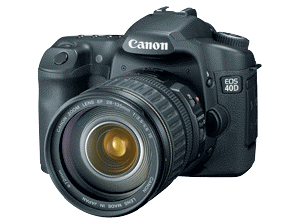
Full Review - Canon EOS D40 Digital SLR Camera


Canon announced the successor to the EOS 30D digital SLR camera in August 2007 - the EOS 40D. The EOS 40D features a 10.1 megapixel sensor along with the latest developments in digital SLR camera technology to produce images worthy of Canon.

Building on the success of Canon's perennially popular "prosumer" EOS 20D and 30D models, the EOS 40D advances the state-of-the-art for mid-range Digital SLR cameras, making it a natural first choice for advanced amateur photographers and entry-level professionals, and an ideal second body for more established photo pros. Indeed, given the level of feature upgrades and improvements, technological wizardry and user-requested creative controls, the Canon EOS 40D SLR's "prosumer" appellation may refer more to its accessible price point than to the exceptional quality, clarity and resolution of the images it creates.

From the camera's newly enhanced, 10.1-megapixel CMOS imaging sensor (designed and manufactured by Canon) and its proprietary and super-efficient DIGIC III image processor, to its completely redesigned autofocus sensor and fast, 6.5 frame-per-second (fps) continuous shooting capability (for bursts of up to 75 Large/Fine JPEGs or 17 RAW images), the EOS 40D SLR puts the fun in functionality and makes serious photo business a positive pleasure.

Indeed, at 6.5 fps, no Digital SLR in the EOS 40D mid-range class and price category has so high a continuous shooting capability, making it ideal for shooting – and actually capturing – speed-sensitive outdoor and wild-nature shots as well as a wide variety of action and sports scenes. The speed of the EOS 40D SLR comes from Canon's balanced combination of its latest processor, DIGIC III, DDR SDRAM high-speed memory, four-channel-per-line sensor readout, and two separate motors for shutter and mirror operation.

"This newest member of Canon's Digital SLR family takes mid-range Digital SLRs to exciting new heights with enhanced resolution and image quality, faster shooting and processing speeds and better overall functionality than ever before," stated Yuichi Ishizuka, senior vice president and general manager, Consumer Imaging Group, Canon U.S.A."The EOS 40D Digital SLR Camera incorporates many Canon innovations and advancements that differentiate our products from the competition, while respecting and reinforcing our long-standing traditions of providing superior value and innovative imaging technology."

Display's the Thing
The most easily visible upgrade on the EOS 40D Digital SLR is the camera's larger three-inch LCD screen (compared with the EOS 30D's 2.5-inch monitor). Still, size is only the beginning of the difference between these two cameras' displays. In order to increase viewing ease in outdoor conditions such as bright sunlight, Canon raised the brightness level of the EOS 40D camera's 230,000-pixel LCD screen, broadened the color gamut and narrowed the viewing angle from 170 degrees to a still wide 140-degree perspective in all directions. An added advantage of the larger-sized display is the ability to use a larger font size for text, making it easier to read setting and menu options on the screen. The camera's menu is organized in the same tabbed format as the EOS-1D Mark III Digital SLR.

Canon extends its "ease-of-reading" policy to the EOS 40D SLR's viewfinder as well. The upgraded viewfinder increases optical magnification from 0.90x to 0.95x, expands the viewing angle from 251 degrees to 264 degrees and raises the eye point from 20mm to 22mm.

Enhanced Durability
Recognizing the often rigorous shooting conditions encountered by professional and advanced amateur photographers, Canon design engineers made the EOS 40D SLR's magnesium alloy exterior even more ruggedly dependable than its predecessors with upgraded dust and weather resistant construction, particularly around the camera's connection ports, battery compartment and single-slot compact flash memory card door. Should the user inadvertently open the compact flash card door while the camera is writing to the card, a warning will pop up on the LCD screen and an open door "alarm" will sound, but the image(s) will continue writing to the memory card without interruption. The EOS 40D SLR also retains many of the outstanding features of the EOS 30D model, such as its fast 0.15-second initial start-up, its extremely durable shutter (rated up to 100,000 cycles), its top shutter speed of 1/8000 sec and 1/250 maximum X-sync flash shutter speed setting.

Improved Image Quality
Although it is based on the image sensor used in the EOS Digital Rebel XTi, the EOS 40D Digital SLR's 10.1-megapixel CMOS APS-C size image sensor has been significantly improved thanks to the use of larger microlenses over each pixel to reduce noise and expand sensitivity up to ISO 3200. The EOS 40D retains the model 30D camera's 1.6x focal length conversion factor (compared to full-frame digital image sensors or 35mm film) and is compatible with the full line-up of Canon EF lenses as well as the Company's expanding selection of high-quality, affordable EF-S lenses created specifically for Canon Digital SLRs with APS-C size image sensors.

Adding to the improved virtuosity of the images captured by the EOS 40D SLR is the camera's 14-bit Analog-to-Digital (A/D) conversion process. Able to recognize 16,384 colors per channel (four times the number of colors recognized by the EOS 30D SLR's 12-bit conversion capability), the EOS 40D camera is able to produce images with finer and more accurate gradations of tones and colors. The EOS 40D also incorporates the optional Highlight Tone Priority and High-ISO Noise Reduction functions first introduced earlier this year with the EOS-1D Mark III Professional Digital SLR.

DIGIC III
DIGIC III is the latest generation of Canon's proprietary image processing engine. DIGIC III technology ensures that the fine details and natural colors of the images are optimally recorded and, as an added bonus, is also responsible for the EOS 40D SLR's high-speed performance, faster signal processing and even its efficient energy consumption.

sRAW
In addition to retaining the RAW image capture capabilities of its predecessors, the EOS 40D SLR now offers a more manageable "sRAW" recording format. In sRAW mode, the number of pixels is reduced to one-fourth that of a standard RAW image and the file size is cut in half, while retaining all of the flexibility and creative possibilities associated with full-size, conventional RAW images.

Improved Autofocus and Exposure Control
While the EOS 40D SLR maintains the nine-point wide area AF coverage first introduced on the EOS 20D camera, Canon has made significant improvements to its speed, precision and functionality, minimizing subject recognition problems in the process. The EOS 40D camera's completely redesigned nine-point AF sensor provides cross-type AF measurement at all nine focusing points for maximum apertures up to f/5.6, and for the first time in any EOS camera, the central AF point offers enhanced precision for both vertical and horizontal subject contrast when using EF or EF-S lenses featuring maximum apertures of f/2.8 or faster. AF calculation speed with the EOS 40D camera is 30 percent faster than the EOS 30D model.

The Canon EOS 40D Digital SLR retains the same 35-zone metering sensor as its predecessor. Available patterns include Evaluative metering, which is linked to all AF points and is set automatically in the Basic Zone modes, Centerweighted average metering, Partial metering and Spot metering, covering approximately 9 percent or 3.8 percent of the viewfinder at center, respectively. The camera's E-TTL II autoflash and 12 exposure control modes (11 AE modes plus manual) are also unchanged from the EOS 30D SLR model. However, as a result of consumer input, Canon has added three Custom exposure modes. As an added convenience, particularly for wireless flash operations, users can adjust the flash settings of the Canon Speedlite 580EX II directly from the camera.

The Canon EOS 40D camera offers ISO speeds from ISO 100 to ISO 1600 in 1/3-stop increments. Users can also opt for a high-speed setting of ISO 3200. For the first time in any EOS camera, the 40D model offers Auto ISO capability in Creative Zone exposure modes. This valuable new feature adjusts the ISO speed to the optimal setting based on low light or shaky shooting conditions. Additionally, the EOS 40D provides full-time display of the active ISO speed setting, both in the viewfinder as well as on the top LCD data panel.

The Canon EOS 40D Digital SLR is also the first camera in its class to offer two interchangeable focusing screens in addition to the standard precision matte screen. Users can opt for a grid-type focus screen that makes it easier to verify horizontal or vertical alignment while determining image composition, as well as the Super-Precision Matte focusing screen that makes it easier to grasp the "sweet spot" of manual focusing when using a lens with a maximum aperture of f/2.8 or faster.

Enhanced Live View
Previously the province of the EOS-1D Mark III DSLR (one of Canon's top-tier professional cameras), the Live View function now gives EOS 40D camera users an expanded and exceedingly convenient and comfortable set of shooting options. By permitting the framing and capturing of subjects using the camera's LCD screen instead of the viewfinder, the shooter gains a 100 percent field view to more easily achieve the desired composition. A new Custom Function on the EOS 40D allows autofocus during Live View by pressing the camera's AF-ON button. At that point, the reflex mirror goes down and AF is carried out in the normal way. Letting go of the AF-ON button resumes Live View functions. Also, in the Live View shooting mode the user can magnify the image by five or ten times in order to ensure that the shot is optimally focused. Live View is at its best during tripod shooting – particularly for close-up photography where precise focusing is imperative. As a side benefit, the Live View shooting mode helps to reduce vibration by lifting the reflex mirror out of the optical path well in advance of the exposure, improving image quality at slow shutter speeds. A new electronic 1st-curtain shutter function in Live View mode reduces release time lag and operational noise even further to avoid spooking wildlife or disturbing people nearby with unwanted camera sounds. Additionally, as the release time lag is miniscule, even instantaneous movements like a bird taking flight can be readily captured.

EOS Integrated Cleaning System
First introduced on the EOS Digital Rebel XTi camera, the EOS Integrated Cleaning System is a prime example of trickle-up technology and is now becoming a standard feature on all new EOS Digital SLRs. The camera's Self-Cleaning Sensor Unit uses ultrasonic vibrations to literally shake dust particles off of the low-pass filter in front of the sensor each time the camera is powered up or shut down. Users also have the option of engaging the "clean now" function at will or bypassing it altogether. Additionally, the EOS 40D SLR's manual sensor cleaning function raises the mirror and allows users to clean dust that has stuck to the low-pass filter. Dust that has been shaken or blown loose is then trapped by adhesive at the base of the sensor unit housing, preventing the problematic particles from reattaching themselves to the filter when the camera moves. The second part of the cleaning system is a software solution that maps the location of any spots that may remain on the sensor. The mapped information is saved as Dust Delete Data and attached to the image file. Subsequently, the offending dust information is subtracted from the final image during post processing with a compatible personal computer, using the supplied Digital Photo Professional software.

Improved Software
Among the most valuable features of the Canon EOS 40D Digital SLR is its compatibility with Canon's Picture Style Editor (PSE) 1.0 software. With PSE, shooters can actually design the look of their photographs by inputting their own preferred style, color and tone curves. The EOS 40D Digital SLR also ships with the latest versions of Canon's powerful software applications, including Digital Photo Professional 3.1 and EOS Utility 2.1, which now support the camera's Remote Live View and Dust Delete Data functions, as well as incorporating a broad range of additional improvements designed to improve image quality and speed up workflow. Also included are ZoomBrowser EX 5.8 and ImageBrowser 5.8 for easy browsing, viewing, printing and archiving with compatible computer operating systems, including Microsoft Windows Vista and Windows XP, as well as Mac OS X.

Accessories
New system accessories for the EOS 40D SLR include the redesigned high-capacity Battery Grip BG-E2N, which facilitates high-volume shooting and easier vertical shooting. Compatible with up to two BP-511A battery packs or a set of six AA-size batteries, the battery grip approximately doubles the number of shots that can be taken, compared with the battery power of the EOS 40D SLR alone. The BG-E2N grip features new sealing material around the battery compartment to better resist water and dust. The new model replaces the original BG-E2 grip and is compatible with the EOS 20D, 30D and 40D models.

Designed exclusively for the EOS 40D SLR, the new Wireless File Transmitter WFT-E3A permits wireless transfer and back-up, as well as remote control of the camera in Live View mode. It can also be connected to various GPS receivers or Hi-Speed USB 2.0 external storage devices such as convenient flash drives or high-capacity hard drives with much larger storage capacity than the memory cards in the camera for instant back-up as images are captured. Compact and affordable, the WFT-E3A wireless transmitter also doubles as a vertical grip and requires its own BP-511A battery pack in addition to the battery installed in the camera body.

EF-S 18-55mm f/3.5-5.6 IS Lens
Developed in response to consumer demand for a high-quality yet affordable optically image stabilized lens, the Canon EF-S 18-55mm f/3.5-5.6 IS standard zoom lens adds a phenomenally flexible lens to the EOS 40D SLR shooter's imaging arsenal. While it features the wide-angle to mid-range zoom flexibility of its non-IS predecessor, this new EF-S 18-55mm f/3.5-5.6 IS lens offers the significant advantage of a true lens-shift image stabilization system that yields up to a full four stops of image-shake correction.

The higher performance provided by Canon's lens shift IS system (compared with the in-camera sensor shift type offered in some competitive SLRs) includes the ability to optimize the lens performance for specific shooting situations such as low-light, long-zoom or movement while shooting (or virtually any combination of the three). What's more, the shooter can see the image stabilization effect in the viewfinder. As the image already appears steady, more accurate framing and composition is possible, the AF point can be placed more precisely, and the photographer can concentrate on the optimal shot more comfortably.

Compact and lightweight, the optional EF-S 18-55mm f/3.5-5.6 IS zoom lens is manufactured by Canon specifically for the EOS 40D SLR and any other EOS SLR that takes EF-S lenses including the EOS 30D, EOS 20D, EOS 20Da, EOS Digital Rebel XTi, EOS Digital Rebel XT and the original EOS Digital Rebel camera.

Digital SLR Camera - Canon EOS 40D

Digital SLR Camera - Canon EOS 40D
The EOS 40D is the latest addition to Canon's line of mid-range, "prosumer" digital SLR cameras, which began with Canon EOS D30 in 2000. Announced in August 2007, the Canon EOS 40D, advances the state-of-the-art for digital SLR cameras specifically targeted at "advanced amateur photographers and entry-level professionals," according to the Canon press release on the EOS 40D digital SLR camera.

The Canon EOS 40D, featuring a maximum resolution of 10.1-megapixel through a CMOS imaging sensor and Canon's own advanced DIGIC III image processor, produces images of exceptional quality and clarity. An ideal blend of functionality and design, the EOS 40D digital SLR camera is also able to produce 6.5 frames-per-second in continuous shooting mode for bursts of up to 75 JPEG digital photographs. Canon has also completely redesigned the autofocus sensor, allowing for fast and precise AF control.

The Canon EOS 40D digital SLR camera has a 3.0 inch LCD display screen, compared with the 2.5 inch screen of its predecessor, the EOS 30D. The screen is also brighter for better visibility and faster menu controls. The viewfinder on the EOS 40D is also an improvement from Canon's previous cameras.

Outward appearances of the Canon EOS 40D digital SLR camera is similar to the previous cameras in the line but according to Canon, the EOS 40D's "magnesium alloy exterior even more ruggedly dependable than its predecessors with upgraded dust and weather resistant construction."

At a Glance
Resolution: 10.1 Megapixels
Dimensions: 5.70 x 2.90 x 4.20 in.
Weight: 1 lb. 10 oz.