Reader's Digest has named Canon the 'most trusted' camera brand in Europe for the eighth straight year. The Reader's Digest Most Trusted Brands Survey 2008 was found to have the highest reputation among consumers in 16 European countries for digital cameras.
LONDON, May 2008 – Canon, world-leader in imaging solutions, has been chosen as Europe's top camera brand for the eighth consecutive year in the Reader’s Digest Most Trusted Brands Survey 2008, an annual pan-European survey of consumer attitudes to brand products and services.
Reader’s Digest, the world’s best-selling monthly magazine, asked its readers in 14 languages across 16 European countries to nominate the brand they trusted most in a range of consumer categories, including cameras. Respondents were drawn from the Reader's Digest customer database of 4.5 million homes in Europe, and a total of 23,651 questionnaires were analysed across the 16 countries.
Canon was one of only four brands nominated as ‘most trusted’ in 13 or more countries including newly added Russia. All brands were judged on quality, image, value for money, environmental responsibility and ethical standards.
James Leipnik, Chief of Communication and Corporate Relations for Canon Europe said: “At Canon, we are focused on providing our customers with excellent imaging solutions that enable them to harness the power of the image at home and in the workplace. It is gratifying that so many readers of the Reader’s Digest across Western and Eastern Europe continue to trust us to deliver solutions and service of the highest quality.”
"Consumer trust is vital to successful brands. Maintaining trust in a fast changing world is one of the biggest challenges facing companies today, especially in the technology sector. For Canon to have improved its position as the most trusted brand of camera in many countries in Europe is impressive" said Gavin Murray, Regional Advertising Director, Europe, Reader’s Digest.
The 13 countries that selected Canon as ‘most trusted’ camera brand were Austria, Belgium, Finland, France, Germany, Hungary, Netherlands, Portugal, Russia, Spain, Sweden, Switzerland and the UK.
Reader's Digest names Canon the 'most trusted' brand
Digital SLR Camera - Canon Rebel XS
Canon has announced its latest digital SLR camera, the EOS 1000D, which will be known as the Canon Rebel XS in North America. Featuring a 10.1 megapixel CMOS sensor and the famous EOS design, the Rebel XS is well poised to be a big hit. Cheaper than its bigger brother, the Canon Rebel XSi, the Rebel XS is expected to appeal to a wider audience and casual photographers making the jump to digital SLR cameras.
The Canon Rebel XS digital SLR camera will have a 2.5 inch LCD screen and Canon's advanced DIGIC III image processing system. Image stabilization is integrated with the Canon lenses meant for the EOS range. The Canon Rebel XS digital camera also features the EOS Integrated Cleaning System that improves clarity and sharpness. Amstelveen, The Netherlands, 10 June 2008 - Canon today announces its latest D-SLR, the EOS 1000D. Featuring a 10.1 Megapixel CMOS sensor, 7-point wide area AF system and up to 3fps continuous JPEG shooting until the memory card is full1, the EOS 1000D represents a more affordable entry point to the world of EOS cameras – whilst taking full advantage of over 70 years of imaging expertise.
With the lightest body of any digital EOS camera, the EOS 1000D incorporates a range of technologies used in Canon's professional EOS-1 series cameras, including the DIGIC III image processor, and Live View mode. For straight-from-the-box shooting, the EOS 1000D is available with a Canon EF-S 18-55mm IS lens – which includes 4-stop image stabilization, ensuring superb performance even in low-light conditions.
“The EOS 1000D is a small camera with a big idea: the supreme adaptability and image quality of the EOS system, in an accessible, affordable package,” said Mogens Jensen, Head of Canon Consumer Imaging Europe. “For anyone ready to take the next step in creative photography, it offers the perfect entry point to the world of D-SLR.”
Features at a glance:
- 10.1 Megapixel CMOS sensor
- EOS Integrated Cleaning System
- 7-point wide-area AF system with f/5.6 cross-type centre point
- Up to 3 frames per second
- 2.5” LCD with Live View shooting
- DIGIC III image processor
- Compatible with SD and SDHC memory cards
- Compact and lightweight body
- Digital Photo Professional RAW processing software
- Fully compatible with all Canon EF and EF-S lenses and EX-series Speedlites
Designed to deliver more
As with all EOS models, key components for the EOS 1000D are designed and manufactured in-house to work with each other for the ultimate image quality. A 10.1 Megapixel CMOS sensor – with larger pixels for smooth, low-noise images – offers sufficient resolution to produce prints in sizes up to A4, even when cropping your image. To protect images against the effects of sensor dust, the EOS 1000D includes the EOS Integrated Cleaning System, which combats dust in three separate ways: reducing, removing and repelling.The EOS 1000D also features a DIGIC III image processor, as used in Canon's professional D-SLR models. This allows continuous shooting until the SD or SDHC memory card is full, at speeds of up to 3fps2 – with the number of shots limited only by the size of the card. DIGIC III also delivers superior image rendering, rapid operation and virtually instant start-up times.
Intelligent focus and flash
For shots where fast focusing is needed, the EOS 1000D features a 7-point wide area Auto Focus system, capable of locking onto a subject in a fraction of a second. A cross-type central focus point continues to operate effectively even when used in lower-light and lower-contrast settings. Also included is E-TTL II, Canon's distance-linked flash exposure system found in professional EOS models.Effortless ease
Weighing just 450g, the EOS 1000D is Canon's lightest D-SLR to date, with a compact, ergonomic body designed for comfortable handling. A bright 2.5” LCD screen lets users instantly review images for composition, sharpness and focus – or, thanks to a wide viewing angle, instantly share shots with friends. The LCD also provides access to a fast, easy-to-read menu system, which uses tabs to avoid unnecessary scrolling. Inherited from the latest EOS models, the menu system includes direct control over external devices such as Speedlite flash units.Photo quality in every situation is aided by 12 custom functions, including Auto Lighting Optimizer - which corrects brightness and contrast during image processing, while improving skin tones in portraits by ensuring correct exposure for faces. Photographers can also enable additional noise reduction for shots captured at high ISO speeds.
Live View
For shooting situations where using the viewfinder is impractical – or where a tripod is used – users can switch to Live View mode, which displays the scene as a smooth, 30fps video feed on the LCD. An optional grid line and histogram display can be selected to help with shot composition and exposure. Two AF modes are available for use with Live View: Quick AF, which momentarily flips the camera's mirror to engage the AF sensor, and Live AF, which uses contrast information for compact camera-style focusing.Software
The EOS 1000D is supplied with a comprehensive software suite that provides all the necessary tools for managing and processing images. This includes Digital Photo Professional (DPP), a powerful RAW converter that provides complete RAW image processing control. DPP also integrates with camera features such as Dust Delete Data and Picture Styles. The supplied Picture Style Editor software can be used to create custom Picture Styles for fine control over colour display. The camera also comes with EOS Utility, Image/Zoom Browser and Photostitch.Digital Cameras - Canon PowerShot SD890 IS, SD790 IS and SD770 IS
Canon's new PowerShot digital cameras feature intelligent features as well as advanced digital photography technologies for the most demanding amateur photographers. The PowerShot SD890 IS, SD790 IS and SD770 IS ELPH digital cameras represent a step forward in compact digital cameras, and all three feature optical image stabilization to reduce blur as well as Canon's advanced image processing engine, the DIGIC III.
All three PowerShot compact digital camera models feature 10 megapixel resolution as well as Canon's face detection and motion detection technologies. The Powershot SD890 IS digital camera features a 5.0X optical zoom lens and a 2.5 inch LCD screen. The Powershot SD790 IS digital camera, meanwhile, features a 3.0X optical zoom lens and a 3.0 inch LCD screen while the Powershot SD770 IS digital camera features a 3.0X optical zoom and a 2.5 inch LCD screen.
These new PowerShot digital cameras were designed with the casual user in mind, and ease of use and functionality were major concerns. They are also elegantly designed and come in beautiful colors. The PowerShot SD890 IS, SD790 IS and SD770 IS ELPH digital cameras are available at manufacturer suggested retail prices of $399.99, $349.99 and $299.99 respectively.
LAKE SUCCESS, N.Y., March 12, 2008 - Whether capturing spur-of-the-moment inspirations or momentous family occasions, Canon U.S.A.'s newest additions to the PowerShot line-up: SD890 IS, SD790 IS and SD770 IS ELPH digital cameras continue to provide intelligent, easy-to-use features, resulting in fantastic photos. Integrated Canon technologies such as Motion Detection Technology, Optical Image Stabilization, Genuine Canon Face Detection Technology, and Canon's proprietary DIGIC III imaging processor, along with the inherent style of the ELPH line; make them the ideal accessory for capturing a night out on the town or an intimate social gathering.
"The Canon PowerShot SD890 IS, SD790 IS and SD770 IS ELPH digital cameras carry on the trend-setting traditions and extend the boundaries of technological ease and the individual sense of style that has always been at the heart of the ELPH line-up," states Yuichi Ishizuka, senior vice president and general manager, Consumer Imaging Group, Canon U.S.A. "Canon continues to draw upon its 70 years of imaging excellence and photographic expertise to develop new technological advancements, as well as create stylish form factors as seen in the iconic box and circle design of ELPH cameras."
Digital Camera Elegance and Excellence
PowerShot SD890 IS ELPH digital camera
This PowerShot SD890 IS ELPH digital camera is a prime example of Canon quality, from the tip of its 5x optically image stabilized, zoom lens to the big and brilliant 2.5 inch PureColor II LCD display embedded in the camera's contoured back. Indeed, it is that very 5x zoom lens that expands the user flexibility by expanding the focusing range from a maximum wide-angle equivalent of a 37mm lens to its maximum optical telephoto equivalent of a 185mm lens. Ideal for capturing everything from broad sweeping vistas to intimate close-ups, the PowerShot SD890 IS Digital ELPH model is also capable of securing macro images from less than an inch away from the subject, making extraordinary, high-resolution nature shots as elementary as point and shoot.From the moment it appears in a user's hand, it is clear that this ELPH digital camera is like none that have come before. From the body's clean lines and smooth, matte silver finish to the topside metallic robe that highlights and accentuates the camera's curves, the 10-megapixel PowerShot SD890 IS ELPH digital camera's alluring proposition is one of beauty, versatility and ability.
This camera's multi-control dial enables the user to simply switch between shooting modes, settings and even images during playback, with easily understandable mode icons displayed on the camera's 2.5-inch PureColor II LCD display. There's even a traditional optical viewfinder for the purists who prefer it.
PowerShot SD790 IS ELPH Digital Camera
The 10-megapixel PowerShot SD790 IS ELPH digital camera's optically image stabilized 3x zoom has a focusing range from a wide-angle equivalent of 35mm to a maximum telephoto equivalent of 105mm. Like the PowerShot SD890 IS ELPH Digital camera, the SD790 IS ELPH digital camera features the quick and easy-to-use multi-control dial.Though smaller than a deck of playing cards, the PowerShot SD790 IS ELPH digital camera conveys a cool, substantial look and feel, thanks to its solid, yet streamlined, chiseled design. Adding to its appeal is the camera's large and highly visible, three-inch PureColor LCD II display, with an adjacent multi-control dial and new button configuration that combine to form a flat control panel.
PowerShot SD770 IS ELPH Digital Camera
The PowerShot SD770 IS ELPH digital camera's classic box and circle design has characterized the Digital ELPH look for more than a decade. This 10-megapixel model boasts the thinnest body of any optically image stabilized ELPH model ever produced, featuring a slimmer yet higher capacity battery pack, that with the camera's power-saving improvements, actually increases the number of photos that can be taken on a single charge to approximately 300 images.Among the key features of the PowerShot SD770 IS ELPH digital camera are a 2.5-inch PureColor LCD II screen and an optical viewfinder as well as the same optically image stabilized 3x zoom as its more senior sibling, the PowerShot SD790 IS ELPH digital camera. The PowerShot SD770 IS ELPH digital camera is offered in the classic matte silver finish with high gloss highlights around the lens barrel and topside edge, and the reprise of Canon's sleek and striking two-tone finish that incorporates matte black highlights around the lens barrel and circle along the camera edge.
Inspired Digital Camera Innovation
Beating The Blur
Among the significant technological advances shared on the new PowerShot SD890 IS, SD790 IS and SD770 IS ELPH digital cameras is Canon's intelligent anti-blur system. Developed by linking four of Canon's most cutting-edge achievements: Optical Image Stabilization, Motion Detection technology, Hi-ISO Auto and Noise Reduction technology, the result is consistently sharp and clear pictures, even when the shooting conditions and circumstances may not be ideal.The most common cause of blurry pictures is actual camera shake. This can be caused by anything from a photographer's unsteady hands to movement in a car along a bumpy road to shots where the zoom lens is extended to a maximum telephoto length or even dimly lit conditions without benefit of flash that causes the shutter to stay open longer in order to admit enough light to make a proper exposure. Canon's proprietary Optical Image Stabilizer (OIS) physically compensates for camera movement and shake by actually shifting the lens (unlike other Image Stabilization systems that merely mask the undesirable movement electronically).
Adding to these ELPH cameras' anti-blur effectiveness, Canon's Motion Detection Technology is linked to the camera's High ISO Auto mode. This improves image clarity by raising ISO speeds (and shutter speeds) for fast-moving subjects (such as a child hitting a baseball from home plate and then running towards first base) or lowering ISO speeds to reduce noise when the subject is stationary. In short, when this impressively intuitive technology detects movement it automatically raises the ISO just enough to reduce image blur. When no movement is detected, it optimally lowers the ISO to reduce noise.
Genuine Canon Face Detection Technology
All three PowerShot ELPH digital cameras feature the latest and most advanced generation of Genuine Canon Face Detection Technology, thus ensuring that up - to nine forward-looking faces in the frame - whether posed for a family portrait, candidly capturing friends and fun, or spontaneously snapping a toddler's expression of triumphant glee as two halting steps - are in focus and properly exposed, with or without flash. In addition to focus and exposure control, the camera's Face Detection feature captures truer, more accurately lit skin tones (and hence more beautifully rendered pictures) thanks to Canon's improved Face Detection White Balance. There's also a new optional "AF Point Zoom" feature that digitally enlarges the face of the main subject on the camera's LCD screen to make it easy to determine the optimum timing for clicking the shutter to capture the moment.In-Camera Image Enhancement
Canon ELPH digital cameras offer an array of in-camera processing features that once required tweaking with computer-based photo software. Now, newly developed Automatic Red-Eye Correction can be engaged while shooting, minimizing the need for correction before printing or sharing images.With Canon's Image Inspection Tool, users can review pictures recently taken on the camera's bright, brilliant and easy-to-read 230,000-pixel PureColor LCD II display by zooming in to ensure that the subjects are in focus and to check for such picture-damning details as closed eyes or inappropriate expressions. What's more, with the ELPH digital camera line's Trimming Function, users can easily crop images, centering and creating memorable close-ups whether they are smiling faces or iconic cityscapes.
DIGIC III Imaging Processor
The "brain" in every new Canon digital camera is Canon's proprietary DIGIC III imaging processor. This exclusive chip is responsible for the camera's higher performance levels including faster start up, faster autofocus and quicker shutter response times that leave long lag competitors far behind. What's more, the DIGIC III processor improves both the image quality and the cameras' power consumption, extending the battery life under typical shooting conditions.In the Boxes
The PowerShot SD890 IS, SD790 IS and SD770 IS ELPH digital cameras are scheduled to be in stores early April, end of March and mid-April respectively. Each of these new, camera kits include a battery pack and charger, a 32MB SD memory card, a USB interface cable, an AV cable, a wrist strap, and Canon's software suite. Each kit carries an estimated retail price of $399.99, $349.99 and $299.99 respectively.Related Links
Steve Digicams - Canon PowerShot SD890 IS Digital Camera Review
Canon Photography in the Parks Photo Contest
Canon's third annual Photography in the Parks Digital Photo Contest aims "to inspire Americans to visit their national and state parks and photograph their beauty." Open from April 22nd to September 30, 2008, digital photographers can photos from parks or monuments in America for a chance to win vacations at participating national parks and Canon digital camera gear. This year's theme is "Inspirational Nature Images." Go to the Canon website for more information on the Photography in the Parks Photo Contest.
LAKE SUCCESS, N.Y., April 24, 2008 – In a continuing effort to inspire Americans to visit their national and state parks and photograph their beauty, Canon U.S.A., Inc., a leader in digital imaging, today announced a call for entries for the third annual Canon Photography In The Parks Photo Contest*. The contest invites eligible photography enthusiasts, from April 22nd to September 30th, 2008, to enter the contest by submitting images from any park or monument in America. Participants are invited to enter their "Inspirational Nature Images," the theme for this year's contest. Canon is also enhancing the photo contest by extending the age range of eligible participants to non-professional photographers ages 13 and up.
"A picture captures a moment in time, but the right picture triggers an emotional reaction within people. Through our Photography in the Parks Photo Contest, we want people to seek out those inspirational images and enjoy the beauty of the outdoors while doing it," stated Yuichi Ishizuka, senior vice president and general manager, Canon U.S.A. "As an environmentally-conscious organization, we encourage everyone to enjoy the beauty of nature, and also to work to protect it."
The Canon Photography in the Parks Photo Contest
From late April to the end of September, photographic enthusiasts are encouraged to submit their favorite photographs from an American park to the Canon Digital Learning Center. The winning photographer will receive a trip to a park of their choice, and a full suite of Canon photographic equipment. By logging onto www.usa.canon.com/parks, potential winners will not only have the opportunity to enter their favorite photos, but also forward an e-postcard of their submitted images to friends and family as a fun way to share their photographs. Visitors and Web surfers can also peruse the Canon Digital Learning Center to explore the various educational resources that Canon has to offer for novices and advanced photographers alike. The Canon Digital Learning Center provides a schedule for a wide variety of classes across the country with renowned photographers. The site also features online tutorials for beginners and professionals to learn their way around a digital SLR camera and professional fine art printers so that Canon users can unlock the creative control that photography affords.Digital Camera - Canon Powershot A590 IS, A580 and A470
Canon has added three new models to its acclaimed line of PowerShot compact digital cameras - the A590 IS, A580 and the A470. All three bring advanced digital photography capabilities at affordable prices for the general user. The new Canon digital cameras also win top marks for innovation, image quality and ease of use.
Both the Canon PowerShot A590 IS and A580 digital cameras offer 8.0 megapixel resolution while the A470 produces 7.1 megapixel digital photos. The PowerShot A590 IS also has optical image stabilization that helps produce higher quality digital photographs, as well full manual settings for truly complete digital photography control.
Optical zoom is an impressive 4.0X on the A590 IS and A580 models while the PowerShot A470 features a 3.4X optical zoom. The DIGIC III image processor delivers stunning digital photo quality in all three models. LAKE SUCCESS, N.Y., January 23, 2008 – Canon U.S.A., Inc. is expanding its acclaimed and perennially popular A-series of PowerShot digital cameras with the introduction of three new, easy-to-use, easy-to-afford, feature-rich models: the optically image stabilized 8.0 megapixel PowerShot A590 IS; the 8.0 megapixel PowerShot A580, and the creatively color-keyed 7.1 megapixel PowerShot A470 digital cameras.
As always, a high level of technological wizardry – forged over Canon's 70 years of imaging innovation and continually refined to meet the photography needs of every user from the tentative first timer to the passionate photo pro – is part of the birthright of every Canon A-series camera. Add in these cameras' ultra-affordable pricing – ranging from an estimated $129 – $179 each – and the ever-present convenience and cost effectiveness of power driven by two AA batteries (rechargeable recommended, but standard alkaline are acceptable) and it is no small wonder that Canon's PowerShot pedigree remains popular among consumers.
"Whether capturing the expression of delight on a child's face amid a flock of brightly colored birthday balloons; the brilliant sunlight as it reflects off newly fallen snow, or the fiery-orange horizon as day slips into night, these three new PowerShot A-series digital cameras make capturing, saving and sharing memories as simple as 1-2-3," said Yuichi Ishizuka, senior vice president and general manager, Consumer Imaging Group, Canon U.S.A.
Canon PowerShot A590 IS Digital Camera
Ruggedly crafted yet lightweight, the dark silver body of the 8.0 megapixel Canon PowerShot A590 IS digital camera fits firmly and comfortably into a user's hand. Featuring an impressive 4x (35mm-140mm equivalent) zoom lens, the PowerShot A590 IS model offers a richer feature set than other entry-level PowerShot cameras.Staking out the upper-middle tier of the PowerShot A-series, the new camera offers users the option of 19 shooting modes, from fully automatic to fully manual operation for greater creative control. The A590 IS camera also features Canon's advanced Optical Image Stabilization (OIS). OIS significantly reduces the effects of camera shake (and the blurry pictures they cause) by actually allowing the lens to shift to compensate for camera movement or shake. Unlike electronic image stabilization systems that essentially mask the movement rather than actually compensating for it, Canon's Optical "lens shift" system preserves the inherent quality of the stabilized image without covering up parts of the image. This OIS technology is even effective when the movement being stabilized is caused by extended telephoto or low-light shooting conditions.
The camera's range can be expanded even further with the use of any one of three optional converter lenses: a 1.75X tele-converter, a 0.7X wide converter and a 52mm close-up lens for eye-catching and frame-filling macro photography. The converter lenses attach over the camera's zoom lens by means of an optional conversion lens adapter.
Canon PowerShot A580 Digital Camera
Sharing most of the features and visual virtues of its image stabilized sibling, the PowerShot A590 IS, including a fast 4X (35mm-140mm equivalent) optical zoom lens, the Canon PowerShot A580 digital camera features an 8.0 megapixel CCD-type image sensor, the option of fully automatic or semi-automatic settings and 16 easily selectable shooting modes. Incorporating a virtually identical body design as its slightly more feature-rich A-series family member, the PowerShot A580 camera is easily distinguished thanks to the pearlescent silver patina of its equally durable shell and easy to hold grip.Canon PowerShot A470 Digital Camera
The successor to last year's successful entry level PowerShot A460 camera, the new 7.1 megapixel Canon PowerShot A470 digital camera has undergone a striking external makeover, matched dramatically by a number of key internal enhancements and advancements. The immediate eye-impact created by the PowerShot A470 camera stems from its availability in four different color accents – blue, red, orange and gray – over a contoured metallic finish body that highlights the camera's new design and reflects the camera user's individuality, personality and taste.This camera's technological features complement its expressive style. Ideal for first time camera-users, the PowerShot A470 camera features a 3.4X (38mm - 132mm equivalent) optical zoom lens that opens up at a responsive f/3.0 at wide-angle and f/5.8 at the telephoto settings. Despite its positioning as an entry-level camera with style, PowerShot A470 camera offers users the option of exploring their creative sides with manual overrides for ISO speed, exposure compensation and white balance, while enjoying the absolute ease of the automatic setting and taking advantage of the camera's 14 shooting modes.
Shared Digital Camera Advancements:
Face Detection Technology
The joy of capturing precious memories of family get-together – without having to make excuses as to why Uncle Joe is deep in the shadows while Aunt Betty's features are completely washed out – is enhanced with Canon Genuine Face Detection Technology. The feature automatically detects, tracks, focuses and optimizes the exposure on up-to nine forward looking human faces in the frame or can lock onto a specific face in the crowd, ensuring that all (or one) are in focus and properly exposed, with or without flash. While the Face Detection algorithm automatically prioritizes up to nine human faces in a scene, it can also be instructed via the Face Select and Track function to lock on to a single face in the crowd, ensuring that the chosen countenance is finely focused, no matter where it appears in the frame. In addition to focus and exposure control, the new A-series cameras now use Face Detection Technology to improve white balance, providing more consistent color accuracy than earlier models.Motion Detection Technology
Canon's innovative and exclusive Motion Detection technology consolidates motion information for both the camera and the photographic subject and determines whether the subject has moved and what if any adjustments to focus or exposure needs to be made. It will even detect and assess subject movement between each frame, making it quicker and easier to capture a series of images. Additionally, when paired with Canon's Optical Image Stabilization system – offered on the PowerShot A590 IS camera among other PowerShot models – the motion detection system's onboard vibration-detecting gyro senses and compensates for movement due to camera shake, even if the subject remains still.Beating the Blur
Among the intuitive innovations built in to the new PowerShot A-series models is the Hi-ISO Auto function that works together with Motion Detection Technology to reduced the effect of blur in low light shooting situations by automatically changing and balancing the ISO sensitivity along with the shutter speed. The result can be a beautifully composed and exposed scene of a child blowing out birthday candles in a dimly lit room, or an atmospheric portrait of a beloved grandparent, captured in the soft, ambient afternoon light.Though equipped with Canon's precise nine-point Autofocus system, the PowerShot A590IS, A580 and A470 models offer an AF-Point Zoom feature that works together with the cameras' advanced Face Detection Technology to enable users to double check facial expressions before snapping photos. Once it has been enabled in the recording menu, AF-Point Zoom can be engaged when photographing people simply by pressing the shutter button halfway. The cameras also feature Canon's Intelligent Orientation Sensor that determines whether a scene is being shot as a vertical or horizontal image. It then automatically rotates the image for quick and easy review on the cameras' bright, sharp and easy-to-read, 115,000-pixel 2.5 inch LCD monitor.
Getting the Red Out
All three of the new A-series PowerShots feature Canon's newly developed Automatic Red Eye Correction, an optional feature that engages while shooting, minimizing the need for correction before printing or sharing images. As an added convenience, the new cameras are compatible with MMC, MMC+ and HC MMC+ memory cards as well as standard SD and SDHC memory cards.DIGIC III Digital Photo Processor
The "brain" in every new Canon digital camera from the PowerShot A-series to the EOS Pro models is the exclusive DIGIC III imaging processor. This proprietary chip is responsible for the cameras' higher performance levels including faster start up, faster autofocus and quicker shutter response times that leave long lag competitors far behind. What's more, DIGIC III improves both the image quality and the cameras' power consumption, extending the battery life under typical shooting conditions.Easy Does It
The new "Easy Mode," available exclusively with the PowerShot A590 IS and A580 models, simplifies camera operation even more than the standard Full Auto mode. Beginning with limiting the active control buttons to two – the shutter button with zoom lever and the flash on/off button – and reducing the number of informational icons on the camera's display, Easy Mode effectively eliminates user confusion and enables newcomers to capture memorable moments without feeling overwhelmed or intimidated by the camera's extensive capabilities.Easy Mode automatically sets the optimal shooting conditions including determining whether to shoot in conventional or macro mode, adjusting the focus and level of flash output for extreme close-ups. What's more, when combined with Face Detection and Motion Detection Technologies, Easy Mode determines the correct exposure for the face even in dark shooting conditions and will adjust the ISO speed to reduce blurring due to subject movement.
Canon "Can Do"
Adding to the Easy Mode ethos that Canon brings to these new PowerShot -series digital cameras is the new Sunset shooting mode, included as part of the cameras' offered Special Scene modes. A staple on all Canon PowerShot cameras, Special Scene modes utilize Canon's extensive photo expertise to assign the optimal camera settings for the shooting conditions selected. Whether indoors or out; in day or night light (and now with the Sunset setting, in-between too) these A- series cameras "know" how to take the best pictures in a vast array of shooting situations. Other Special Scene modes help make impressive images even when shooting through aquarium glass; across snowy vistas and sandy beaches, or into lush, colorful foliage or at a brilliant burst of fireworks against a black satin sky.For all of their automatic allure, the new A-series PowerShot cameras offer more experienced users a full complement of useful features and a comprehensive menu of selectable scene settings that can feed the creative impulse or help make the most out of any picture-perfect moment. The PowerShot model A590 IS even offers a full manual setting that maximizes the shooter's creative control, making each image a truly personal expression.
In the Boxes
Scheduled to appear in stores beginning in March 2008, both the PowerShot A590 IS and the PowerShot A580 digital camera kits. include two standard AA alkaline batteries, a 32MB MMC+ Memory card, a USB interface cable, an AV cable, a wrist strap, and Canon's software suite. The kits carry estimated retail prices of $179.99* and $149.99*, respectively. The PowerShot A470 digital camera kit is also scheduled to ship in March, with similar standard accessories at an estimated retail price of $129.99.** Prices are estimated retail prices. Actual selling prices are set by dealers and may vary. Availability, specifications and prices are subject to change without notice.
Digital SLR Camera - Canon Rebel XSi/EOS 450D
 The Rebel XSi is Canon's latest entry into the advanced digital SLR camera market, placing superior optics and the advanced features into the hands of photo enthusiasts. Featuring a 12.2 megapixel CMOS sensor and a 3.0 inch LCD screen, the Rebel XSi delivers excellent digital photographs and easy previewing options.
The Canon Rebel XSi also incorporates Canon's advanced DIGIC III image processor "ensures superior image rendering and rapid response times." Fully compatible with all Canon EF and EF-S lenses, the Rebel XSi is truly a powerful digital SLR camera capable of producing beautiful digital photographs.
Canon's EOS Integrated Cleaning system is also included in the Rebel XSi, thereby producing cleaner images. Canon also features a compact, streamlined body. The Technical Image Press Association (TIPA) named the Canon Rebel XSi (known as the Canon EOS 450D in Europe) the best advanced digital SLR camera for 2008.
Visit the Official Canon Rebel XSi Digital SLR Camera Website
Read the Canon Rebel XSi Digital SLR Camera Review
Digital Camera Info - Canon Rebel XSi Digital SLR Camera Review
Full Review - Canon Rebel XSi Digital SLR Camera
 Canon's new EOS Rebel series digital SLR camera - the Rebel XSi - places superior optics and the latest professional features into the hands of emerging photo enthusiasts. Together with optically image stabilized lenses, the new Rebel is a serious contender in the advanced digital SLR camera market. The Canon Rebel XSi is known as the Canon EOS 450D in Europe.
LAKE SUCCESS, N.Y., January 23, 2008 – Canon U.S.A., Inc.'s EOS Rebel series of digital single lens reflex cameras – the cameras that defined and refined what it means to be an "entry level" digital SLR – have now redefined the gateway prowess and "pro-ness" of the DSLR category with the introduction of the line's new leader, the 12.2-megapixel EOS Rebel XSi camera. Incorporating a number of high-end functions and technology found in Canon's professional SLR models, the EOS Rebel XSi camera boasts an improved autofocus sensor, enhanced 14-bit A/D conversion, an advanced Live View function, and the proprietary DIGIC III image processor. When paired with any of the more than 60 compatible Canon EF and EF-S lenses, including optically image stabilized EF-S lenses like the EF-S18-55mm f/3.5-5.6 IS – now included in the EOS Rebel XSi kit – or the new EF-S55-250mm f/4-5.6 IS, the EOS Rebel XSi DSLR delivers images that will delight and inspire family and friends at an entry level price tag.
"This new EOS Rebel XSi digital SLR camera is the answer for those who have been waiting to make the leap from digital point-and-shoot to digital SLR or from an older SLR to the latest generation of advanced technology, while still including the creative controls their old camera afforded them," states Yuichi Ishizuka, senior vice president and general manager, Consumer Imaging Group, Canon U.S.A.
Luxury Feel and Function
At first glance, one notices the Rebel XSi digital SLR camera's large, 3-inch LCD monitor, enhanced from the 2.5-inch screen on the Digital Rebel XTi model. The larger 230,000 pixel screen makes it easier for users to review images and scroll through the Rebel XSi digital SLR camera's menus. The larger-sized display provides the ability to use a larger font size for menu text, making it easier than ever to read settings and options. The new screen also features a broadened color gamut, seven brightness settings for easy viewing under a variety of shooting conditions and a wide viewing perspective in all directions.The EOS Rebel XSi digital SLR camera features a substantial yet streamlined profile, with curved edges, contoured surfaces, conveniently placed controls and comfortably constructed rubber grip and thumb rest that all contribute to fatigue-reducing hand fit. The digital SLR camera body is constructed of a rugged yet lightweight combination of stainless steel and polycarbonate embedded with glass fiber. The chassis exterior is enrobed in a durable ABS and Polycarbonate resin and offered in a choice of silver or black finishes.
Improved Image Quality
At the heart of the new EOS Rebel XSi digital SLR camera is its newly designed 12.2 megapixel APS-C size Canon CMOS sensor. This new sensor employs large microlenses over each pixel to reduce noise and enhance sensitivity up to ISO 1600, which is ideal for high-quality images in low light. The APS-C size sensor retains a 1.6x focal length conversion factor compared to full-frame digital image sensors or 35mm film format cameras.Another image quality enhancement is the upgrade of the Analog-to-Digital (A/D) conversion process to a 14-bit A/D processor. The inclusion of the 14-bit A/D process means the Rebel XSi camera records up to 16,384 colors per channel and allows the camera to produce images with finer and more accurate gradations of tones and colors. This is ideal for shooting outdoors where subtle hue changes in sky, water or foliage can really add to an image.
The Canon EOS Rebel XSi DSLR also incorporates the optional Highlight Tone Priority and High-ISO Noise Reduction functions first introduced in 2007 with the EOS-1D Mark III Professional Digital SLR camera and now available for the first time in an entry level Canon digital SLR camera. Additionally, the new camera is equipped with Canon's Auto Lighting Optimizer technology, which corrects image brightness and contrast automatically. Introduced last year in the EOS 40D digital SLR camera, this valuable optional feature now works in all exposure modes and utilizes Face Detection technology to prevent underexposure with backlit faces.
DIGIC III Image Processor
If the 12.2-megapixel APS-C size CMOS sensor is the heart of the digital SLR camera, then Canon's DIGIC III processor is the brain. The latest generation of Canon's proprietary image processing engine, DIGIC III technology ensures that the fine details and natural colors of the images are optimally recorded. The DIGIC III processor also manages the digital SLR camera's efficient energy consumption and high-speed signal processing performance. The EOS Rebel XSi is the first model in the Rebel series to incorporate DIGIC III.Enhanced Live View
Introduced in 2007 on the EOS-1D Mark III DSLR, this function makes its debut in an entry level Canon DSLR with the EOS Rebel XSi digital SLR camera. Live View allows users to frame shots through the LCD screen rather than the viewfinder. Going beyond the manual focus and phase-detection AF capabilities of earlier EOS models with Live View, the EOS Rebel XSi digital SLR camera adds a new "Live Mode" contrast-detection AF function that allows the camera to focus automatically during Live View without lowering the reflex mirror.Improved Autofocus and Framing Rate
The EOS Rebel XSi Digital SLR camera utilizes a precise nine-point Autofocus (AF) system featuring a newly developed AF sensor that improves the digital SLR camera's subject detection capabilities compared to earlier models. The new Rebel XSi DSLR provides a cross-type AF measurement at the center that's effective with all EF and EF-S lenses, while providing enhanced precision with lenses having maximum apertures of f/2.8 or faster. The cross-type AF measurement reads a wider variety of subject matter than conventional single-axis AF sensors and thus increases the new digital SLR camera's ability to autofocus quickly and accurately. The EOS Rebel XSi is also the fastest firing Rebel model to date, capable of continuously capturing 3.5 frames per second for bursts of up to 45 images in large/fine JPEG mode and 6 frames in RAW mode. The faster frame rates and finer focusing capabilities of the Rebel XSi together with its impressive image burst rate will help digital photo enthusiasts preserve family milestones or capture split second sports action at just the right moment.EOS Integrated Cleaning System
The new Rebel XSi DSLR utilizes Canon's EOS Integrated Cleaning system, first introduced on the EOS Rebel XTi digital SLR camera. The camera's Self-Cleaning Sensor Unit shakes dust particles off of the low-pass filter in front of the sensor. The dust is then trapped by an adhesive along the base, preventing it from causing further nuisance. Cleaning is engaged each time the digital SLR camera is powered up or shut down or manually through the "clean now" function.The second part of the cleaning system involves post processing with a compatible personal computer and the supplied Digital Photo Professional software. Here the camera maps any spots that may remain on the sensor, saving it as Dust Delete Data and subsequently subtracting dust spots from the final image during post processing. A third option includes a manual sensor cleaning function which raises the mirror and allows users to clean dust that may have stuck to the low-pass filter.
Back to the Basics
In keeping with its EOS system heritage, the new Canon EOS Rebel XSi digital SLR camera is equipped with a host of useful creative controls, including shutter speeds ranging from 1/4000 sec. to 30 sec. plus Bulb, a choice of four metering patterns including 4% spot metering (another first for the Rebel series), a wide range of exposure modes from fully automatic to fully manual, depth of field preview, mirror lock and much more. The new digital SLR camera is fully compatible with all Canon EF and EF-S lenses, as well as EX-series Speedlites, an optional Battery Grip, and remote control and viewfinder accessories.A departure from previous EOS Digital Rebel models, which accommodated CF type memory cards, the new EOS Rebel XSi digital SLR camera utilizes SD and SDHC memory cards including those with capacities higher than 2GB, making it the perfect upgrade for users already equipped with SD cards from point-and-shoot model cameras. Additionally, the EOS Rebel XSi camera utilizes Canon's new high-capacity LP-E5 lithium ion battery pack, which provides 50% more exposures per charge than earlier models with virtually no increase in size or weight.
In the Box
Expected to ship in April 2008 the Canon Rebel XSi digital SLR camera is available in body-only configuration which includes a rechargeable battery pack and charger, USB and video cables, a neckstrap, an EOS Solutions Disk CD, and a 1-year Canon U.S.A., Inc. limited warranty. The new camera will also be available in a lens kit version which includes everything in the body-only kit plus the EF-S18-55mm f/3.5-5.6 IS zoom lens. The two versions carry estimated retail prices of $799.99 and $899.99, respectively.EF-S 18-55mm f/3.5-5.6 Image Stabilizer Lens
First introduced in August of 2007, the Canon EF-S 18-55mm f/3.5-5.6 IS zoom lens is Canon's answer to consumer demand for a high-quality yet affordable optically image stabilized lens and is included as the standard lens in the Rebel XSi kit configuration. The lens features the wide-angle to mid-range zoom flexibility of its non-IS predecessor with the significant advantage of Canon's true optical, lens-shift image stabilization system that yields up to a full four stops of image-shake correction.The higher performance provided by Canon's lens shift IS system (compared with the in-camera body sensor shift type offered in some competitive SLRs) includes the ability to optimize the lens performance for specific shooting situations such as low light, long-zoom or movement while shooting (or virtually any combination of the three). What's more, the photographer can see the optical image stabilization effect in the viewfinder. As the image already appears steady in the viewfinder or on the screen through the Rebel XSi Live View function, better framing and composition is possible allowing the photographer to concentrate on the best shot more comfortably.
EF-S55-250mm f/4-5.6 IS Lens
Like the standard kit lens, the optional EF-S55-250mm f/4-5.6 IS zoom lens offers users of Canon EOS Digital SLRs with APS-C type CMOS sensors an affordable, lightweight, high-performance lens with tremendous range and flexibility. Given the 1.6x conversion factor inherent in the APS-C sized sensor, the high zoom ratio of this EF-S 55-250mm lens actually achieves the equivalent focal length of 88-400mm (in 35mm format).Canon's true optical, lens shift image stabilizer offers users an equivalent shutter speed that is approximately 4 settings faster, making hand-held lower light or long zoom photos easier to capture without blurring. What's more, the lens can automatically distinguish between normal shooting and panning shots and select the optimum Image Stabilizer mode for each.
In stores now, both the EF-S 18-55mm f/3.5-5.6 IS and the EF-S55-250mm f/4-5.6 IS zoom lenses are manufactured by Canon specifically for the EOS Rebel XSi , EOS 40D and every other EOS SLR that takes EF-S lenses including earlier Digital Rebel cameras and the EOS 20D, EOS 20Da, and EOS 30D models. Though standard in the EOS Rebel XSi kit, the EF-S 18-55mm f/3.5-5.6 IS lens is also available as a stand alone purchase and carries an estimated retail price of $199.99. The optional EF-S55-250mm f/4-5.6 IS lens is available at an estimated retail price of $299.99.
TIPA Photography 2008 Award Winners
The Technical Image Press Association (TIPA) has announced the results of the annual camera Oscars for 2008. The TIPA awards are one of the most coveted photo and imaging awards in Europe. Manufacturers especially are interested in the award as they can place the TIPA logo on their products.
This year, Nikon scooped the Pro and Expert categories with the D3 and D300 respectively. These victories are further evidence of Nikon gaining ground on its traditional rival - Canon. Canon, though, managed to win a gong for the best "advanced" DSLR with its EOS 450D, not a bad feat as for a camera that started shipping a few days ago.
The Winners
Best Entry-Level Digital SLR Camera: Sony Alpha A200
Best Advanced Digital SLR Camera: Canon EOS 450D
Best Expert Digital SLR Camera: Nikon D300
Best Professional Digital SLR Camera: Nikon D3
Best Ultra Compact Digital Camera: Samsung NV24HD
Best Compact Digital Camera: Panasonic Lumix FX-500
Best Superzoom Digital Camera: Fuji S100 FS
Best Entry-Level Lens: Canon EF-S 55-250mm f/4-5.6 IS
Best Expert Lens: Olympus Zuiko Digital ED 12-60mm f/2.8-4 SWD
Best Professional Lens: Nikon AF-S NIKKOR 14-24mm f/2.8G ED
Best Flatbed Photo Scanner: Canon CanoScan 8800F
Best Small Format Photo Printer: HP Photosmart A826
Best Expert Photo Printer: Epson Stylus Photo R1900
Best Multifunction Photo Printer: Canon PIXMA MP970
Best Large Format Printer: Epson Stylus Pro 11880
Click the link for the full list of TIPA photography award winners.
Advanced Techniques - Hacking Canon Firmware
Supercharge Your Canon Digital Camera with Open-Source CHDK Firmware
from Wired How-To WikiONLY FOR CERTAIN CANON DIGITAL CAMERAS!
 It has become apparent that digital cameras have capabilities beyond what is immediately available to the user. On a standard Canon, for example, the fastest shutter speed option offered is 1/1,600 second, but the hardware can actually handle much more than that - up to 1/60,000 of a second.
The Canon Hacker's Development Kit, or knows as CHDK, is an open-source software project that can be loaded on cameras using Canon's DIGIC II or DIGIC III firmware platforms. It unleashes new features including RAW file format, live histogram display, a battery readout, in addition to the ability to run scripted actions on a camera.
The good news is that CHDK does not replace the existing firmware on your Canon, so the process is completely reversible. The existing firmware stays intact, while the CHDK software is loaded on demand from an SD card.
How To Install It
It's best to start with a blank SD card, so if there are pictures on your card, remove them first.There are numerous incarnations of the CHDK software, different builds incorporating different features. If you don't have a particularly rare camera or unusual needs, the best build to start with is probably the Allbest build, a good all-purpose build that incorporates a majority of features.
Determine which camera model you own, by looking at the model number on the camera. Download the appropriate CHDK package for your digital camera from this site.
Note: The "Ixus" designation is European: what Americans call the Canon SD800, Europeans call the Ixus 850. The filename of the firmware should include both names, e.g. allbest-ixus850_sd800-100e-49.zip.
Also download the "english.lng" language file.
Unzip the zip file. It should contain two files, DISKBOOT.BIN and PS.FIR. Put your SD card in your card reader and copy those files, plus english.lng, to the topmost directory on your card.
Once you've put those files on your card, put the card back in the camera.
How To Use It
Switch the camera into View (not Shoot) mode, and turn it on. When you press the Menu button, you should notice a new menu option: Firm Update. Select this option (remember, it's non-destructive) and the CHDK software will be loaded on your camera, which should reboot itself. Immediately, you'll see a display of battery percentage and storage remaining.The extra features can be accessed and configured via "Alt mode," an alternate mode into which you toggle by pressing a particular key. On the SD700, it's the Print key; it may be different on your camera. It should be configurable in the Alt menu.
You can tell you're in Alt mode when there's a little "ALT" displayed at the bottom of the screen.
After entering Alt mode, press the Menu key to bring up the menu. This reveals all sorts of options: customizing the on-screen display (called the "OSD"), playing games, you name it. Use the camera's directional keys to navigate the menu.
Play Around
Your camera is now set up to take all kinds of fancy photos. You can do Edgerton-style high-speed digital photography, or low-light high-ISO tricks, or script complex actions. The CHDK wiki includes lots of digital photography tips and tutorials and user-written scripts. Here are some of our favorites:- Unlimited Interval Shooting - Use your camera for surveillance, or use it to shoot at precise intervals during a lunar eclipse or meteor shower.
- High-Speed Shutter - Use this override option in the AllBest firmware to explore life's littler moments. You can also override the camera's slowest shutter speed settings to shoot exposures of a minute or longer.
- Long Exposure Intervalometer - Take multiple long exposure shots all night, then assemble the shots into your own time lapse videos.
- Shoot better HDR pics with CHDK's auto-bracketing features.
Set CHDK as Your Default
At this point, CHDK is only loaded manually when you select Firm Update as you did above. When you shut the camera off, it'll be gone (although your configuration options are stored in a config file on your card). If you want to have it load automatically every time you turn on the camera, follow these steps:- Go to Debug Parameters in the Alt menu, and select "Make card bootable."
- Turn off the camera, remove the card, and switch its manual switch to Lock position. If your card doesn't lock, you can't auto-boot CHDK, sorry.
- Put the card back in. Now CHDK will load automatically whenever you turn on the camera. Unlock the card to disable this.
Full Review - PowerShot SD1100 IS

The PowerShot SD1100 IS Digital ELPH camera is offered in five lyrically named designer shades that suit the style, present the personality and express their user’s taste and tempo. From the eclectic mix of antique elegance and au courant accessorizing of Bohemian Brown; the shimmering chic and subtle heat of Pink Melody; the wistful and occasionally wild stirrings of Rhythm and Blue, and of course, the exquisite refinement and enduring appeal of precious metals conveyed by the PowerShot SD1100 IS Digital ELPH camera dressed only in its Golden Tone skin or catching the array of light -- both brilliant and soft—as it plays on the camera body’s Swing Silver sheen, these cameras capture the images at hand while conveying a picture of their users worth at least a thousand words.
Still, the PowerShot SD1100 IS Digital ELPH camera is not just another pretty face. This feature-rich, pocket-sized, 8.0 megapixel, optically image stabilized digital camera is firmly rooted in the traditions of photo excellence and imaging innovation that Canon is known for.
“We recognize that many Digital ELPH camera users view their cameras as statements of personal style, valued as much for the image they convey as the images they capture,” said Yuichi Ishizuka, senior vice president and general manager, Consumer Imaging Group, Canon U.S.A. “The color choices of the PowerShot SD1100 IS Digital ELPH camera create additional opportunities for personalization and individual expression.”
A Sharp Zoom Lens with Image Stabilization
Adding to the new camera's versatility and optical excellence is its sharp and fast 3X optical zoom lens (38-114mm equivalent opening up to f/2.8 at wide-angle settings and f/4.9 at telephoto settings). The PowerShot SD1100 IS Digital ELPH camera also features Canon’s advanced Optical Image Stabilization (OIS) system that significantly reduces the image-blurring effects of camera shake by shifting the lens to compensate for the movement. Available for the first time in an entry level Digital ELPH, Canon’s OIS technology is proven effective for extended telephoto shots as well as low-light shooting conditions and helps users get the best possible picture quality every time.
Genuine Face Detection Technology
Beyond their appeal on the social scene, the PowerShot SD1100 IS Digital ELPH cameras feature the latest and most advanced generation of Canon’s Genuine Face Detection technology, thus ensuring that up to nine forward looking faces in the frame – whether posed for a family portrait, candidly capturing friends and fun, or spontaneously snapping a toddler’s expression of triumphant glee as two halting steps – are in focus and properly exposed, with or without flash. In addition to focus and exposure control, the SD1100 IS camera’s Face Detection feature captures truer, more accurately lit skin tones (and hence more beautifully rendered pictures) thanks to Canon’s improved face detection white balance.
Face Selection and Motion Detection Technology
While the face detection algorithm automatically prioritizes up to 9 human faces in a scene, it can also be instructed via the Face Select and Track function to lock on to a single face in the crowd, ensuring that the chosen countenance is finely focused, no matter where it appears in the frame. Additionally, a new Motion Detection function linked to the camera’s High ISO Auto mode improves image clarity by raising ISO speeds (and shutter speeds) for fast-moving subjects or lowering ISO speeds to reduce noise when the subject is stationary. These automatic advances provide even more ways for the PowerShot SD1100 IS Digital ELPH cameras to optimize picture quality with seamless ease.
DIGIC III
The “brain” in every new Canon digital camera is Canon’s proprietary DIGIC III imaging processor. This exclusive chip is responsible for the cameras’ higher performance levels including faster start up, faster autofocus and quicker shutter response times that leave long lag competitors far behind. What’s more, DIGIC III improves both the image quality and the cameras’ power consumption, extending the battery life under typical shooting conditions.
See and be Scene
The PowerShot SD1100 IS Digital ELPH camera offers users a choice of 18 shooting modes including a fully automatic mode that makes these cameras a true point-and-shoot affair; a semi-automatic “Camera M” mode which allows access to features such as Exposure Compensation and White Balance adjustments that Full Auto mode does not, as well as a plethora of scene selection modes – including Canon’s new Sunset mode -- that optimize image results under a variety of shooting conditions.
These scene modes put the power of Canon’s collective photo expertise into the hands of even the most rookie shooter, ensuring that in the end, the shots are the best that they can be, whether indoors or out; in day or night light (and now, with the Sunset setting, in between too); through an aquarium glass; across stark snowy vistas or bleached sandy beaches; into lush, colorful foliage or at a brilliant burst of fireworks against a black satin sky.
The PowerShot SD1100 IS Digital ELPH cameras feature Canon’s precise 9-point Autofocus system along with the new AF-Point Zoom feature that work together with Face Detection Technology to allow users to double check the facial expressions of their subjects, when shooting under more challenging conditions. After activating the feature in the camera’s menu, the AF-Point Zoom can be engaged simply by pressing the shutter button halfway.
Streamlining the image review process, Canon’s Intelligent Orientation Sensor determines whether a scene is being shot as a vertical or horizontal image and automatically adjusts it for quick and easy review on the camera’s bright, sharp and easy to read, 230,000 pixel 2.5 inch Pure Color LCD II
screen. The Image Inspection Tool feature zooms in on faces automatically during playback to make it even easier to check facial expressions. The new cameras also feature Canon’s newly-developed Automatic Red Eye Correction that engages in the shooting mode, minimizing the need for correction before printing or sharing images. In-Camera Trimming is yet another new advancement that allows users to adjust and save cropped versions of their images without using a computer. As an added convenience, the PowerShot SD1100 IS Digital ELPH cameras are compatible with MMC, MMC+ and HC MMC+ memory cards as well as standard SD and SDHC memory cards.
Digital Camera - Canon Powershot SD1100 IS
 The Powershot SD1100 IS is Canon's latest model in its ELPH line of fashionable compact digital camera. Elegant in design and offered in five different colors, the Powershot SD1100 IS nonetheless produces excellent digital photos. Ideal for the casual photographer, the SD1100 IS has a maximum resolution of 8.0 megapixel, 3x optical zoom lens and 4x digital zoom.
Full Review - Canon EOS D40 Digital SLR Camera

Canon announced the successor to the EOS 30D digital SLR camera in August 2007 - the EOS 40D. The EOS 40D features a 10.1 megapixel sensor along with the latest developments in digital SLR camera technology to produce images worthy of Canon.
Building on the success of Canon's perennially popular "prosumer" EOS 20D and 30D models, the EOS 40D advances the state-of-the-art for mid-range Digital SLR cameras, making it a natural first choice for advanced amateur photographers and entry-level professionals, and an ideal second body for more established photo pros. Indeed, given the level of feature upgrades and improvements, technological wizardry and user-requested creative controls, the Canon EOS 40D SLR's "prosumer" appellation may refer more to its accessible price point than to the exceptional quality, clarity and resolution of the images it creates.
From the camera's newly enhanced, 10.1-megapixel CMOS imaging sensor (designed and manufactured by Canon) and its proprietary and super-efficient DIGIC III image processor, to its completely redesigned autofocus sensor and fast, 6.5 frame-per-second (fps) continuous shooting capability (for bursts of up to 75 Large/Fine JPEGs or 17 RAW images), the EOS 40D SLR puts the fun in functionality and makes serious photo business a positive pleasure.
Indeed, at 6.5 fps, no Digital SLR in the EOS 40D mid-range class and price category has so high a continuous shooting capability, making it ideal for shooting – and actually capturing – speed-sensitive outdoor and wild-nature shots as well as a wide variety of action and sports scenes. The speed of the EOS 40D SLR comes from Canon's balanced combination of its latest processor, DIGIC III, DDR SDRAM high-speed memory, four-channel-per-line sensor readout, and two separate motors for shutter and mirror operation.
"This newest member of Canon's Digital SLR family takes mid-range Digital SLRs to exciting new heights with enhanced resolution and image quality, faster shooting and processing speeds and better overall functionality than ever before," stated Yuichi Ishizuka, senior vice president and general manager, Consumer Imaging Group, Canon U.S.A."The EOS 40D Digital SLR Camera incorporates many Canon innovations and advancements that differentiate our products from the competition, while respecting and reinforcing our long-standing traditions of providing superior value and innovative imaging technology."
Display's the Thing
The most easily visible upgrade on the EOS 40D Digital SLR is the camera's larger three-inch LCD screen (compared with the EOS 30D's 2.5-inch monitor). Still, size is only the beginning of the difference between these two cameras' displays. In order to increase viewing ease in outdoor conditions such as bright sunlight, Canon raised the brightness level of the EOS 40D camera's 230,000-pixel LCD screen, broadened the color gamut and narrowed the viewing angle from 170 degrees to a still wide 140-degree perspective in all directions. An added advantage of the larger-sized display is the ability to use a larger font size for text, making it easier to read setting and menu options on the screen. The camera's menu is organized in the same tabbed format as the EOS-1D Mark III Digital SLR.
Canon extends its "ease-of-reading" policy to the EOS 40D SLR's viewfinder as well. The upgraded viewfinder increases optical magnification from 0.90x to 0.95x, expands the viewing angle from 251 degrees to 264 degrees and raises the eye point from 20mm to 22mm.
Enhanced Durability
Recognizing the often rigorous shooting conditions encountered by professional and advanced amateur photographers, Canon design engineers made the EOS 40D SLR's magnesium alloy exterior even more ruggedly dependable than its predecessors with upgraded dust and weather resistant construction, particularly around the camera's connection ports, battery compartment and single-slot compact flash memory card door. Should the user inadvertently open the compact flash card door while the camera is writing to the card, a warning will pop up on the LCD screen and an open door "alarm" will sound, but the image(s) will continue writing to the memory card without interruption. The EOS 40D SLR also retains many of the outstanding features of the EOS 30D model, such as its fast 0.15-second initial start-up, its extremely durable shutter (rated up to 100,000 cycles), its top shutter speed of 1/8000 sec and 1/250 maximum X-sync flash shutter speed setting.
Improved Image Quality
Although it is based on the image sensor used in the EOS Digital Rebel XTi, the EOS 40D Digital SLR's 10.1-megapixel CMOS APS-C size image sensor has been significantly improved thanks to the use of larger microlenses over each pixel to reduce noise and expand sensitivity up to ISO 3200. The EOS 40D retains the model 30D camera's 1.6x focal length conversion factor (compared to full-frame digital image sensors or 35mm film) and is compatible with the full line-up of Canon EF lenses as well as the Company's expanding selection of high-quality, affordable EF-S lenses created specifically for Canon Digital SLRs with APS-C size image sensors.
Adding to the improved virtuosity of the images captured by the EOS 40D SLR is the camera's 14-bit Analog-to-Digital (A/D) conversion process. Able to recognize 16,384 colors per channel (four times the number of colors recognized by the EOS 30D SLR's 12-bit conversion capability), the EOS 40D camera is able to produce images with finer and more accurate gradations of tones and colors. The EOS 40D also incorporates the optional Highlight Tone Priority and High-ISO Noise Reduction functions first introduced earlier this year with the EOS-1D Mark III Professional Digital SLR.
DIGIC III
DIGIC III is the latest generation of Canon's proprietary image processing engine. DIGIC III technology ensures that the fine details and natural colors of the images are optimally recorded and, as an added bonus, is also responsible for the EOS 40D SLR's high-speed performance, faster signal processing and even its efficient energy consumption.
sRAW
In addition to retaining the RAW image capture capabilities of its predecessors, the EOS 40D SLR now offers a more manageable "sRAW" recording format. In sRAW mode, the number of pixels is reduced to one-fourth that of a standard RAW image and the file size is cut in half, while retaining all of the flexibility and creative possibilities associated with full-size, conventional RAW images.
Improved Autofocus and Exposure Control
While the EOS 40D SLR maintains the nine-point wide area AF coverage first introduced on the EOS 20D camera, Canon has made significant improvements to its speed, precision and functionality, minimizing subject recognition problems in the process. The EOS 40D camera's completely redesigned nine-point AF sensor provides cross-type AF measurement at all nine focusing points for maximum apertures up to f/5.6, and for the first time in any EOS camera, the central AF point offers enhanced precision for both vertical and horizontal subject contrast when using EF or EF-S lenses featuring maximum apertures of f/2.8 or faster. AF calculation speed with the EOS 40D camera is 30 percent faster than the EOS 30D model.
The Canon EOS 40D Digital SLR retains the same 35-zone metering sensor as its predecessor. Available patterns include Evaluative metering, which is linked to all AF points and is set automatically in the Basic Zone modes, Centerweighted average metering, Partial metering and Spot metering, covering approximately 9 percent or 3.8 percent of the viewfinder at center, respectively. The camera's E-TTL II autoflash and 12 exposure control modes (11 AE modes plus manual) are also unchanged from the EOS 30D SLR model. However, as a result of consumer input, Canon has added three Custom exposure modes. As an added convenience, particularly for wireless flash operations, users can adjust the flash settings of the Canon Speedlite 580EX II directly from the camera.
The Canon EOS 40D camera offers ISO speeds from ISO 100 to ISO 1600 in 1/3-stop increments. Users can also opt for a high-speed setting of ISO 3200. For the first time in any EOS camera, the 40D model offers Auto ISO capability in Creative Zone exposure modes. This valuable new feature adjusts the ISO speed to the optimal setting based on low light or shaky shooting conditions. Additionally, the EOS 40D provides full-time display of the active ISO speed setting, both in the viewfinder as well as on the top LCD data panel.
The Canon EOS 40D Digital SLR is also the first camera in its class to offer two interchangeable focusing screens in addition to the standard precision matte screen. Users can opt for a grid-type focus screen that makes it easier to verify horizontal or vertical alignment while determining image composition, as well as the Super-Precision Matte focusing screen that makes it easier to grasp the "sweet spot" of manual focusing when using a lens with a maximum aperture of f/2.8 or faster.
Enhanced Live View
Previously the province of the EOS-1D Mark III DSLR (one of Canon's top-tier professional cameras), the Live View function now gives EOS 40D camera users an expanded and exceedingly convenient and comfortable set of shooting options. By permitting the framing and capturing of subjects using the camera's LCD screen instead of the viewfinder, the shooter gains a 100 percent field view to more easily achieve the desired composition. A new Custom Function on the EOS 40D allows autofocus during Live View by pressing the camera's AF-ON button. At that point, the reflex mirror goes down and AF is carried out in the normal way. Letting go of the AF-ON button resumes Live View functions. Also, in the Live View shooting mode the user can magnify the image by five or ten times in order to ensure that the shot is optimally focused. Live View is at its best during tripod shooting – particularly for close-up photography where precise focusing is imperative. As a side benefit, the Live View shooting mode helps to reduce vibration by lifting the reflex mirror out of the optical path well in advance of the exposure, improving image quality at slow shutter speeds. A new electronic 1st-curtain shutter function in Live View mode reduces release time lag and operational noise even further to avoid spooking wildlife or disturbing people nearby with unwanted camera sounds. Additionally, as the release time lag is miniscule, even instantaneous movements like a bird taking flight can be readily captured.
EOS Integrated Cleaning System
First introduced on the EOS Digital Rebel XTi camera, the EOS Integrated Cleaning System is a prime example of trickle-up technology and is now becoming a standard feature on all new EOS Digital SLRs. The camera's Self-Cleaning Sensor Unit uses ultrasonic vibrations to literally shake dust particles off of the low-pass filter in front of the sensor each time the camera is powered up or shut down. Users also have the option of engaging the "clean now" function at will or bypassing it altogether. Additionally, the EOS 40D SLR's manual sensor cleaning function raises the mirror and allows users to clean dust that has stuck to the low-pass filter. Dust that has been shaken or blown loose is then trapped by adhesive at the base of the sensor unit housing, preventing the problematic particles from reattaching themselves to the filter when the camera moves. The second part of the cleaning system is a software solution that maps the location of any spots that may remain on the sensor. The mapped information is saved as Dust Delete Data and attached to the image file. Subsequently, the offending dust information is subtracted from the final image during post processing with a compatible personal computer, using the supplied Digital Photo Professional software.
Improved Software
Among the most valuable features of the Canon EOS 40D Digital SLR is its compatibility with Canon's Picture Style Editor (PSE) 1.0 software. With PSE, shooters can actually design the look of their photographs by inputting their own preferred style, color and tone curves. The EOS 40D Digital SLR also ships with the latest versions of Canon's powerful software applications, including Digital Photo Professional 3.1 and EOS Utility 2.1, which now support the camera's Remote Live View and Dust Delete Data functions, as well as incorporating a broad range of additional improvements designed to improve image quality and speed up workflow. Also included are ZoomBrowser EX 5.8 and ImageBrowser 5.8 for easy browsing, viewing, printing and archiving with compatible computer operating systems, including Microsoft Windows Vista and Windows XP, as well as Mac OS X.
Accessories
New system accessories for the EOS 40D SLR include the redesigned high-capacity Battery Grip BG-E2N, which facilitates high-volume shooting and easier vertical shooting. Compatible with up to two BP-511A battery packs or a set of six AA-size batteries, the battery grip approximately doubles the number of shots that can be taken, compared with the battery power of the EOS 40D SLR alone. The BG-E2N grip features new sealing material around the battery compartment to better resist water and dust. The new model replaces the original BG-E2 grip and is compatible with the EOS 20D, 30D and 40D models.
Designed exclusively for the EOS 40D SLR, the new Wireless File Transmitter WFT-E3A permits wireless transfer and back-up, as well as remote control of the camera in Live View mode. It can also be connected to various GPS receivers or Hi-Speed USB 2.0 external storage devices such as convenient flash drives or high-capacity hard drives with much larger storage capacity than the memory cards in the camera for instant back-up as images are captured. Compact and affordable, the WFT-E3A wireless transmitter also doubles as a vertical grip and requires its own BP-511A battery pack in addition to the battery installed in the camera body.
EF-S 18-55mm f/3.5-5.6 IS Lens
Developed in response to consumer demand for a high-quality yet affordable optically image stabilized lens, the Canon EF-S 18-55mm f/3.5-5.6 IS standard zoom lens adds a phenomenally flexible lens to the EOS 40D SLR shooter's imaging arsenal. While it features the wide-angle to mid-range zoom flexibility of its non-IS predecessor, this new EF-S 18-55mm f/3.5-5.6 IS lens offers the significant advantage of a true lens-shift image stabilization system that yields up to a full four stops of image-shake correction.
The higher performance provided by Canon's lens shift IS system (compared with the in-camera sensor shift type offered in some competitive SLRs) includes the ability to optimize the lens performance for specific shooting situations such as low-light, long-zoom or movement while shooting (or virtually any combination of the three). What's more, the shooter can see the image stabilization effect in the viewfinder. As the image already appears steady, more accurate framing and composition is possible, the AF point can be placed more precisely, and the photographer can concentrate on the optimal shot more comfortably.
Compact and lightweight, the optional EF-S 18-55mm f/3.5-5.6 IS zoom lens is manufactured by Canon specifically for the EOS 40D SLR and any other EOS SLR that takes EF-S lenses including the EOS 30D, EOS 20D, EOS 20Da, EOS Digital Rebel XTi, EOS Digital Rebel XT and the original EOS Digital Rebel camera.
Digital SLR Camera - Canon EOS 40D
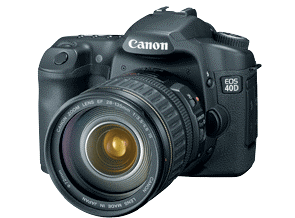
The EOS 40D is the latest addition to Canon's line of mid-range, "prosumer" digital SLR cameras, which began with Canon EOS D30 in 2000. Announced in August 2007, the Canon EOS 40D, advances the state-of-the-art for digital SLR cameras specifically targeted at "advanced amateur photographers and entry-level professionals," according to the Canon press release on the EOS 40D digital SLR camera.
Resolution: 10.1 Megapixels
Dimensions: 5.70 x 2.90 x 4.20 in.
Weight: 1 lb. 10 oz.
Search

Links


